

The most damaging hotel reviews don’t start at check-in. A family booked through an OTA, arrived at a five-star adults-only resort with a seven-year-old, and were turned away in forty-degree heat — €1,600 paid. The hotel’s policy was correct. What failed was the pre-arrival relationship. Here’s what the data shows.
Hotel managers read a bad review and ask the same question: what went wrong during the stay? It is a reasonable instinct. The stay is what you control. The stay is where the staff were, where the food was served, where the room either met expectations or did not.
But there is a category of damaging review that did not start during the stay. It started weeks earlier, when a guest formed an expectation – about what the hotel offered, who it was for, what they would find when they arrived – and the hotel never corrected it.
This kind of review is more damaging than most, and more common than it should be. Understanding why it happens is the first step to preventing it.
The asymmetry in the damage
Not all negative reviews are equal. A guest who encounters a service failure during the stay – slow room service, a noise complaint handled badly, a meal that disappointed – will typically leave a two or three-star review. They are frustrated, but they are reporting on an experience they had.
A guest who arrives with a fundamentally wrong picture of the hotel leaves a one-star review. The tone is different. The language is different. These reviews do not describe disappointment. They describe feeling misled. The damage to the property’s reputation is disproportionate to whatever operational failure caused it, because the reader of that review cannot easily distinguish between a hotel that misled a guest and a hotel that simply failed to communicate clearly through a third party.
The distinction matters enormously to the manager. To the prospective guest reading the review, it is invisible.
A policy that existed. A guest who never saw it.
Consider the case of a five-star adults-only resort in Crete. The hotel’s own booking flow makes the restriction explicit: guests are asked for the number of travellers, with the label “age: 16+”. The policy is there. The hotel communicates it – on its own channels.
A family travelling with a seven-year-old did not book through the hotel’s website. They booked through a third-party platform, paid over €1,600 for four nights, and arrived to find they could not check in. The adults-only restriction had not been surfaced clearly enough in the OTA interface they used. They stood outside in forty-degree heat with a child and no alternative arranged. The review they left rated the hotel one star.
The policy was not wrong. The hotel had not made a false claim. What failed was the pre-arrival relationship – or rather, the absence of one. The family’s entire picture of the stay had been built through the OTA. The hotel’s own voice had never reached them.
This is not a hypothetical edge case. It is a precise illustration of what happens when a hotel’s identity – its policies, its offer, its character – exists clearly on its own channels and nowhere else. Guests who find the hotel through OTAs get a filtered version. The filter is not malicious. But it is incomplete, and the hotel pays for the gaps.
Rising volume, falling ratings
The same resort recorded its highest-ever review volume in 2025 – 124 reviews in a single year, up from 81 in 2024 and 89 in 2023. Its rating for the same period fell to 4.20, its lowest since the post-pandemic trough of 2021, against an all-time average of 4.44.
More guests writing reviews, saying worse things. This is not a coincidence. It reflects a broader dynamic across the competitive set: peer average ratings in the same region dropped to 4.13 over the last twelve months, well below the longer-term average of 4.49. Expectations are rising – partly because OTAs present properties at their best, in curated images and headline ratings, and guests arrive having bought into a picture that the day-to-day reality has to live up to.
At a certain level of the market, the physical product is increasingly hard to differentiate. Rooms are good. Food has been invested in. Service is trained. What is not keeping pace is the direct relationship between hotel and guest in the window between booking and arrival – the period when expectations are formed, when questions go unanswered, and when the OTA’s version of the hotel becomes the only version the guest knows.
Building the pre-arrival relationship back
The solution is not to abandon OTA distribution – the volume it generates is real and necessary. The solution is to build a parallel channel: one that reaches guests directly, in the hotel’s own voice, before they arrive.
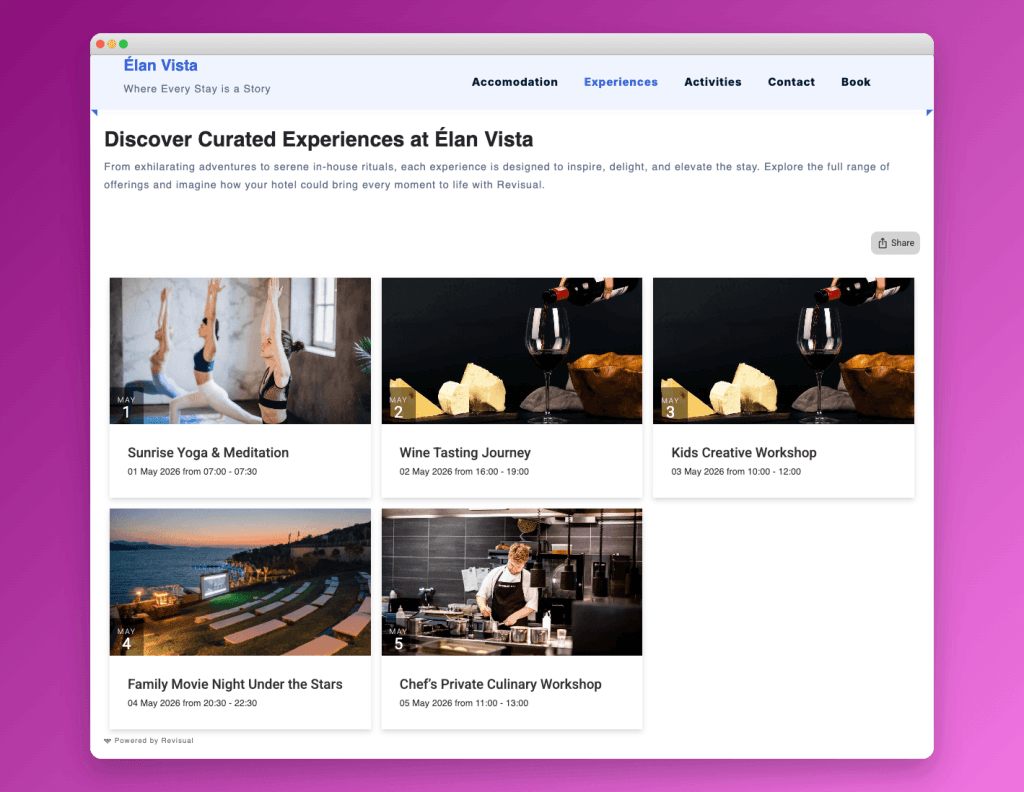
For most hotels, this means three things. First, a website events and information page that is genuinely current – not a static page updated seasonally, but a live view of what the property offers, what is running during a guest’s stay, what the key policies are. A guest researching a booking should be able to find the hotel’s own version of itself, not just the OTA’s.
Second, a pre-arrival email that is actually informative – not a generic “we look forward to welcoming you” message, but a communication that tells the guest what to expect, what is happening during their stay, and what they need to know before they arrive. This is the moment to surface policies, confirm the offer, and begin shaping the experience before check-in.
Third, continuity between those channels – so the events page, the email, the in-lobby display, and the QR code on the confirmation all draw from the same source. When something changes, it changes everywhere. No guest arrives with information that was accurate two weeks ago but is not accurate today.
This is the infrastructure Revisual provides. A single Google Calendar becomes the source of record for the property’s programme – and Revisual distributes it automatically to the hotel website, pre-arrival emails, lobby displays, and printed collateral. The hotel’s voice reaches the guest through every channel, consistently, before the stay begins.
The family turned away in the heat is an extreme outcome. But the dynamic that produced it – a hotel that communicated well on its own channels and nowhere that particular guest was looking – plays out at lower stakes in almost every property, every season. The reviews it generates are rarely one-star. But they are the ones that contain the phrase “not what we expected.”
That phrase is the sound of a pre-arrival relationship that was never built.

About the author
Piotr Pozniak
Piotr’s is the cofounder of Revisual, a dedicated tool for seamlessly sharing events. With over six years of experience developing the platform, he brings extensive expertise in streamlining business processes through technology solutions. Work with partners across industries has honed his ability to optimize event workflows and enhance data accessibility.

