

A hotel can programme excellent events and still leave guests feeling like nothing was happening. The gap is not in the events — it is in how they are communicated. This article makes the case that event communication is not a marketing task to be delegated. It is part of the product.
Two hotels. Similar rooms, similar service standards, similar price point. One feels meticulously managed. The other feels like a good place to stay. Guests can rarely articulate the difference in concrete terms – they just know it when they experience it.
Some of that difference lives in the physical details: the quality of the linen, the temperature of the pool, the ratio of staff to guests. But a significant part of it lives in something less tangible and less discussed: the degree to which guests feel informed, prepared, and attended to before a single interaction with a staff member has taken place.
Events – the activities, experiences, and programmes a hotel offers – are one of the clearest expressions of a hotel’s character and ambition. A jazz evening, a chef’s table, a sunrise yoga session, a wine tasting curated by the sommelier. These are the things guests remember and tell people about. They are also, in most hotels, communicated as an afterthought.
This article makes a specific argument: that the way a hotel communicates its events programme is not a marketing task to be delegated. It is part of the product itself – and treating it as such is one of the most direct ways to differentiate in a market where physical product differences are increasingly marginal.
The ceiling on physical differentiation
At a certain level of the market, rooms stop being a meaningful differentiator. A five-star hotel in any major city offers a bed that is genuinely excellent, a bathroom that is genuinely well-appointed, and service that is genuinely attentive. So does the hotel next door. So does the one across the street.
This is not a new observation. Hospitality strategists have been writing about the shift from amenity competition to experience competition for a decade. What is less often said is that the experience layer has its own ceiling – and it is reached faster than most hotels expect.
Programming a great wine tasting is achievable. Programming a great wine tasting consistently, across a full calendar, across multiple seasons, requires investment that most comparable properties make. The resulting experience programmes start to look similar. The sommelier is different. The wines are different. The setting is different. But the format, the ambition, and the price point converge.
What does not converge is the communication layer around those experiences. Because most hotels treat event communication as a secondary task – something handled by whoever updates the website, whoever prints the lobby newsletter, whoever posts to social media – the execution varies enormously even between properties of similar standing. This is where differentiation remains genuinely possible. Not in the events themselves, but in the quality, consistency, and accessibility of how they are communicated.
The experience begins before departure
A guest planning a stay does not begin their experience at check-in. They begin it when they start researching – reading reviews, exploring the hotel website, deciding whether this property offers what they are looking for.
At this stage, most hotel websites present events in one of two ways: as a static page listing a handful of recurring activities with minimal detail, or not at all. Neither creates the impression of a property with a rich, considered programme of experiences. Neither gives the guest something to look forward to, something to plan around, something to mention to their travelling companion.
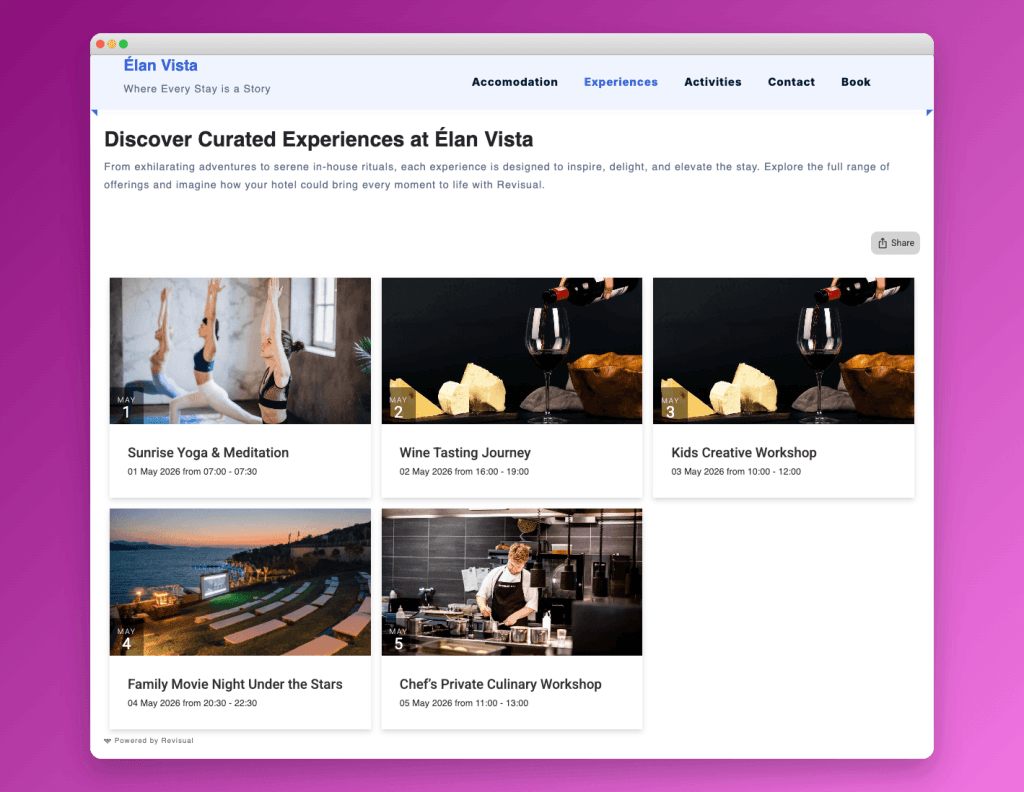
Compare this to the guest who finds an events page that shows the full programme for their stay – a wine tasting on Thursday evening, a jazz pianist in the restaurant on Friday, a guided coastal walk on Saturday morning. Each entry has an image, a description, a time, and a way to find out more or reserve a spot. The guest does not just see a list of activities. They start constructing a picture of their stay. They begin anticipating it.
That anticipation is not a minor detail. It changes the emotional register of the trip before it has begun. It creates the sense that this hotel has thought carefully about what it offers and how it presents itself. It produces, in other words, exactly the confidence and trust that luxury hospitality promises.

The communication layer during the stay
A guest arrives. They are shown to their room. In the welcome pack – or on the room screen, or at the concierge desk – there is a way to see what is happening during their stay. Not a printed sheet that may be out of date. A current, accessible, easy-to-browse programme.
A QR code on the welcome leaflet. A display in the corridor showing today’s and tomorrow’s programme. A link in the check-in email. The format matters less than the principle: the guest can always find out what is happening, from wherever they are, without asking.
That availability changes behaviour. A guest who knows there is a wine tasting at seven considers it when deciding whether to eat out or stay in. A guest who finds out about the jazz evening only because they happen to walk past the restaurant at the right moment may still enjoy it – but the hotel has missed the opportunity to shape the evening rather than be discovered by accident.
The difference between these two scenarios is not the quality of the event. It is the quality of the communication around it. The first creates the impression of a hotel that is looking after its guests. The second creates the impression of a hotel where things happen without coherent presentation.
Events as a direct revenue driver
Beyond brand impression, a well-communicated events programme has a direct effect on in-house revenue that is easy to underestimate.
Consider the restaurant. A hotel restaurant competes not just with other hotel restaurants but with every dining option available to the guest. A guest who has not made a dinner plan may default to going out – particularly in a city with obvious alternatives. A guest who knows that tonight features a famous jazz pianist and that the restaurant has availability at eight is making a different calculation. The event is a reason to stay. The communication is what makes the event visible at the moment the decision is being made.
The same logic applies to spa bookings, activity sign-ups, private dining, and any other revenue-generating experience the hotel offers. The events listing is not just a notice board. With the right call to action – a reservation link, a booking prompt, a direct contact – it is a conversion mechanism.
This does not require aggressive promotion. It does not require repeated push notifications or discount offers. It requires that the information is present, current, and accessible at the moment a guest is ready to make a decision. That moment can happen at midnight on the website before departure, at breakfast on the first morning, or when scanning a QR code while waiting for the lift. The communication layer is what ensures the event is there to be found at each of those moments.

The operational argument
There is a practical dimension to this that general managers understand immediately. A well-organised, publicly visible events calendar does not just serve guests. It serves the hotel operationally.
When the concierge, the restaurant manager, the activities coordinator, and the front desk all have access to the same current events information, the answers they give guests are consistent. A guest asking ‘what is happening this evening?’ receives the same answer regardless of who they ask. That consistency is itself a quality signal. It communicates that the hotel is organised, that its people are informed, and that the experience it promises is delivered coherently.
The alternative – multiple people maintaining different versions of the events calendar, or relying on a printed weekly sheet that may not reflect recent changes – creates exactly the opposite impression. An event cancelled but not communicated. A time changed but only some staff aware. These are small failures, but in the context of a guest who is paying to be looked after, they register.
The review at the end of the stay
A guest who has had a seamless, well-communicated experience of the hotel’s events programme arrives at the review moment in a different state than one who has not.
They have anticipated the stay. They have discovered and planned activities. They have had the impression, throughout, that the hotel is organised and attentive. They have made decisions – dinner reservations, activity bookings – that resulted in experiences they valued. The communication layer has not just informed them. It has shaped the stay.
The five-star review is not given for any single moment. It is given for the cumulative impression of a stay that felt, from first research to final morning, like it was thoughtfully managed. The events programme – and specifically the quality of how it was communicated – is one of the most consistent contributors to that impression.
Most hotels programme events well. Few communicate them with the same care. That gap is both the problem and the opportunity.
A note on how Revisual approaches this
Revisual was built on exactly this understanding. The platform does not create events – it makes existing event programmes visible, consistent, and accessible across every channel a guest might encounter: the hotel website, lobby and corridor displays, QR codes on printed collateral, email communications. All of it drawing from a single source, all of it updating automatically when the programme changes.
What this transparency layer also provides is something most hotels do not currently have: measurable feedback on event engagement. Which events attract the most interest before the stay? Which QR codes are scanned most frequently, and at what time of day? Which links are shared? This is not marketing data in the conventional sense – it is intelligence about what guests actually want to experience, surfaced through the quiet signal of their attention. For a general manager thinking seriously about programming, it is the beginning of a different kind of conversation.

About the author
Piotr Pozniak
Piotr’s is the cofounder of Revisual, a dedicated tool for seamlessly sharing events. With over six years of experience developing the platform, he brings extensive expertise in streamlining business processes through technology solutions. Work with partners across industries has honed his ability to optimize event workflows and enhance data accessibility.

